
The Series / Booklet Ten
Booklet Ten
When the Chessboard Burns
Strategy, Readiness, Destiny, and the Moment Bhagavān Opens
This booklet begins where strategy fails. The seeker has planned, counter-planned, anticipated, defended, and arranged the pieces, only to discover that life is not a chessboard and the pieces do not obey. It is not against strategy; it asks who is using it—fear, ego, dharma, or Bhagavān’s work.
Booklet Ten
Opens as a book: turn the pages, set the type and paper, and pick up where you stopped.
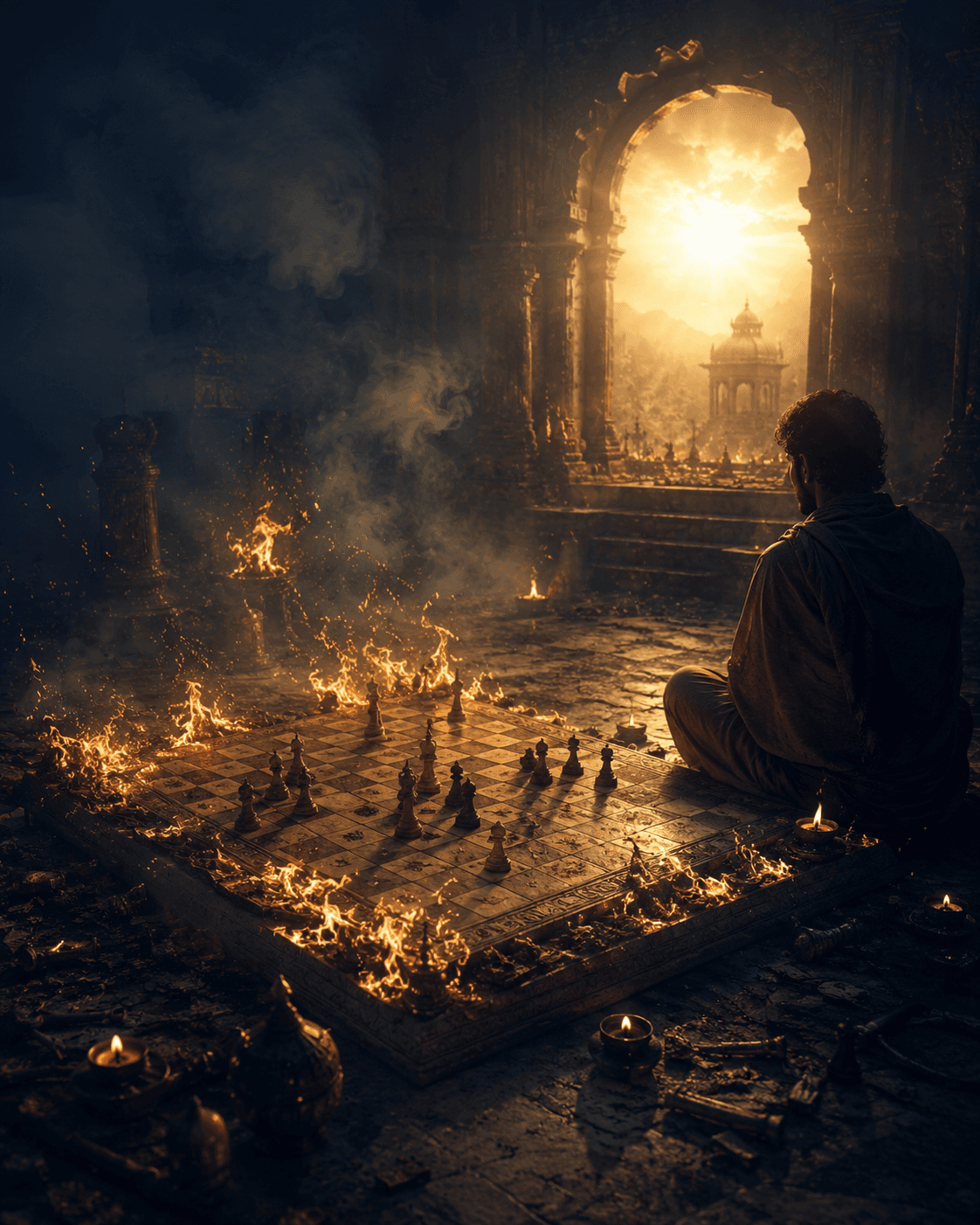
When the Chessboard Burns
Strategy, Readiness, Destiny, and the Moment Bhagavān OpensSasidhar ValluruTheValluru.OrgOpening: The If-Then Mind
1. The Chessboard We Build in the Head 2. Strategy Is Not the Enemy 3. Śakuni Plays the Board 4. Krishna Sees the Field 5. Duryodhana Wanted Outcome; Arjuna Accepted Work 6. Hanuman in Lanka: Watch, Weigh, Then Burn 7. Vidura: Counsel Without Ownership 8. The Prepared One Waits Differently 9. Destiny Is Not an Excuse to Sleep 10. When the Moment Opens 11. The Gist
Epilogue: The Next Trap Is Happiness
Author’s Note
This booklet follows The Witnesses Who Remain. That booklet asked why certain beings remain in the long memory of dharma. Why Vyāsa remains. Why Hanuman remains. Why Mahabali, Kṛpa, Paraśurāma, Vibhīṣaṇa, Mārkaṇḍeya, and even Aśvatthāma remain. The answer was witness. Not decorative immortality. Witness. Each one remains because the lesson is not finished. Human beings still need to learn what knowledge is not, what strength is not, what surrender is, what atonement is, what duty looks like without glamour, and how long Bhagavān’s work can be.
The moment comes. And the board burns.
This booklet asks the next question. If Bhagavān’s work is long, how does the seeker live inside the waiting? Because this is where people start scheming. We plan. We counter-plan. We prepare narratives. We manage perception. We hype. We dehype. We leak. We deny. We position. We reposition. We build alliances. We read faces. We decode silences. We ask what if this happens, what if that fellow moves, what if she says that, what if they think this, what if the village turns, what if the office whispers, what if the family judges, what if the market shifts, what if the gods themselves seem to have left the meeting without minutes. This is human. But it is also exhausting.
The question is not whether strategy is useful. The question is: who is using it?
The mind builds a chessboard and then worships the board. It thinks the one who sees the most moves will win. It thinks cleverness is the same as readiness. It thinks narrative is the same as truth. It thinks timing can be bullied by anxiety. Then the moment comes. And the board burns. The one who stands is not always the one who planned the most. It is the one who was prepared at the core. The one who had strength. The one who sharpened the tool. The one who stayed awake without becoming restless. The one who waited without rotting. The one who trusted destiny without sleeping through opportunity. This booklet is not against strategy. That would be childish.
Śrī Krishna strategized. Śrī Rāma strategized. Hanuman observed Lanka before acting. Vidura advised. Chanakya existed for a reason. Even a mother planning how to feed three children with two vegetables and one gas cylinder is doing strategy of a higher order than most corporate decks. The question is not whether strategy is useful. The question is: who is using it? Fear? Ego? Dharma? Bhagavān’s work? That difference is everything.
Opening
The If-Then Mind
The mind loves if-then.
If he says this, I will say that. If she moves first, I will wait. If they build a narrative, I will counter it. If this group turns cold, I will warm that group. If they hype, I will dehype. If they dehype, I will create scarcity. If the boss hears this, I will say that. If the family asks this, I will answer that. If the village thinks I failed, I will make sure they see me succeed. If the world does not understand me, I will manufacture a world that does. On and on. The mind becomes a small sweating clerk inside a large dark room, stamping papers that nobody asked for.
We laugh at strategy decks. Then we live inside one.
Plan A. Plan B. Plan C. Counter-plan. Counter-counter-plan. Side narrative. Backup explanation. Exit line. Face-saving sentence. Reputation hedge. Spiritual explanation. Moral justification. One neat version for public use, one version for close friends, one version for the mirror, one version for Bhagavān in case He is also asking questions. We laugh at strategy decks. Then we live inside one.
One cannot calculate all this. One can only prepare.
This is not only politics. I am not speaking of politics in the small newspaper sense. I am speaking of political narrative as human behavior. Families have politics. Offices have politics. Friend circles have politics. Temples have politics. Literary groups have politics. WhatsApp groups have politics. Even two children fighting over the bigger mango piece can produce high-quality diplomatic theatre if given enough time. The human being is a narrative animal. He does not merely act. He explains the act before, during, and after. He wants to know how he is seen. He wants the story to sit correctly. He wants the event to carry the right meaning. He wants the tribe to interpret him safely. So he manages perception. Sometimes this is necessary. Communication matters. Reputation matters. Trust matters. Social life is not lived in a vacuum. If someone walks around saying, “I do not care what anyone thinks,” he usually cares enough to announce it loudly. That is also perception management. Just the cheaper version with more attitude.
The problem begins when perception replaces reality. Then the seeker gets trapped. He starts maintaining the image of strength instead of building strength. He starts managing the story of discipline instead of becoming disciplined. He starts performing readiness instead of preparing. He starts talking of destiny while quietly begging for control. And Bhagavān watches. Patiently. Because Bhagavān has seen this movie before. The mind thinks life is a chessboard. But life is not a chessboard. The pieces do not obey us. The board does not stay still. The opponent is not one person. Time is not neutral. Karma is not visible. Grace is not predictable. The guṇas are moving. Other people have their own prārabdha, their own wounds, their own cleverness, their own stupidity, their own gods, their own ghosts, and their own unfinished lessons. One cannot calculate all this.
One can only prepare. That is the doorway of this booklet. Not how to outscheme the world. How to stand ready when the chessboard burns.
Chapter 1
The Chessboard We Build in the Head
The first chessboard is not outside. It is in the head. Before anyone has moved, we move them. Before anyone has spoken, we hear them. Before anyone has betrayed us, we prepare the speech. Before anyone has insulted us, we rehearse the injury. Before anyone has honoured us, we design the humility. The mind is efficient that way. Hopelessly efficient.
It can suffer in advance. It can fight in advance. It can win imaginary arguments in the bathroom. It can lose imaginary wars at 3:00 a.m. It can award itself medals for battles nobody else attended. This is where strategy becomes māyā. Māyā is not only mist, illusion, cosmic projection, metaphysical error, and all the usual textbook furniture. Māyā is also the mental board on which we keep arranging imagined pieces. That person is against me. This person is secretly with me. That fellow is waiting. This one can be influenced. That one is weak. This one is dangerous. That one must be watched. This one must be fed. That one must be starved. This one must be praised. That one must be exposed.
The first chessboard is not outside. It is in the head.
All of this may sometimes be partly true. That is what makes it dangerous. Pure nonsense is easier to reject. Half-truth is the professional weapon of māyā. A person says, “I am only being practical.” Maybe. Or maybe fear has hired practicality as legal counsel. A person says, “I am only protecting myself.” Maybe. Or maybe insecurity has taken the driver’s seat and is calling itself prudence. A person says, “I am only managing the situation.” Maybe. Or maybe the ego cannot tolerate that the situation is not fully manageable. This is the first hard point.
Strategy is not the enemy. Fear-strategy is.
The strategist is often not strong. He is anxious. He may look sharp. He may talk well. He may anticipate. He may build many if-then branches. He may know people’s weaknesses. He may use silence like a knife and speech like a rope. But inside, very often, he is afraid. Afraid of losing control. Afraid of losing place. Afraid of losing image. Afraid of being ordinary. Afraid of being exposed. Afraid that if he stops moving the pieces, the board will reveal that he never owned the game. That is why over-strategy is tiring. It is not intelligence alone. It is fear wearing intelligence. The seeker must see this without becoming sentimental. Because there is another trap. Once one sees the ugliness of manipulation, one may say, “Fine. I will not plan. I will just surrender.” Wonderful. But what does that mean?
If surrender means laziness, it is not surrender. It is tamas taking a bath. If surrender means not sharpening the tool, not learning the craft, not strengthening the body, not disciplining speech, not watching the field, not preparing for the moment, then it is not spiritual maturity. It is negligence with a tilak. So we need a sharper distinction. Strategy is not the enemy. Fear-strategy is.
Chapter 2
Strategy Is Not the Enemy
Let us be clear. Only fools despise strategy. A farmer plans when to sow. A mother plans meals. A surgeon plans the incision. A driver watches the road. A king must know enemies and allies. A project leader must know risk. A warrior must know terrain. A seeker must know his own weaknesses.
Even silence can be strategy. There are times when speaking is dharma. There are times when silence is dharma. There are times when waiting is cowardice. There are times when waiting is wisdom. There are times when striking quickly is ego. There are times when delay is betrayal of duty. Life is not kind enough to give us one rule and let us sleep. This is why dharma is not mechanical. Dharma requires seeing. Strategy becomes clean when it serves dharma. Strategy becomes dirty when it serves fear, greed, vanity, revenge, or possession.
Only fools despise strategy.
The same act can look similar outside and be completely different inside. Two people may wait. One waits because he is afraid. Another waits because the fruit is not ripe. Two people may speak. One speaks to clarify truth. Another speaks to control perception. Two people may build alliances. One does it to protect a larger work. Another does it because he cannot stand alone. Two people may prepare. One prepares because Bhagavān has given him work. Another prepares because his ego wants applause when the work succeeds. The outside may not tell the whole story. The inner movement matters. This is where the seeker must become honest. Not publicly honest first. That is easy to perform. Privately honest. Inwardly honest. Honest in that place where the mind cannot arrange chairs for an audience.
The outside may not tell the whole story. The inner movement matters.
Why am I planning? To serve, to protect, to clarify, to prepare — or to control? The answer may not be clean. Human beings are mixtures. One part may be dharma; one part fear; one part love; one part pride; one part old wound; one part genuine responsibility; one part pure nonsense carried from childhood like inherited furniture no one likes but no one throws away. That is all right. The point is not to become theatrically pure by tomorrow morning. The point is to see. Because once seen, the movement begins to change.
Both understand strategy. But they do not stand in the same place.
That is the difference between Śakuni and Krishna. Both understand strategy. But they do not stand in the same place.
Chapter 3
Śakuni Plays the Board
Śakuni is one of the great warnings of the Mahabharata. Not because he is stupid. He is not. That is the problem. A stupid villain is easy. He breaks something, shouts, fails, and exits. Śakuni is more dangerous because he understands weakness. He understands vanity. He understands resentment. He understands delay. He understands the intoxication of grievance. He knows how to feed Duryodhana without healing him. That is a special form of evil. Some people do not create the wound. They keep it alive. They visit it daily, garland it, feed it ghee, and say, “See? I alone understand your pain.”
Śakuni knows the board. Dice, ego, inheritance, insult, ambition, palace insecurity, the blind father’s weakness, the wounded prince’s hunger, the silence of elders, the pressure of public event — he understands all these moving parts. But what is his center? Not dharma. Not healing. Not balance. Not truth. His center is grievance sharpened into manipulation. That is why Śakuni is useful for this booklet. He is not the fool who never planned. He is the one who planned too well from the wrong place. He plays the board because he cannot leave the wound. He is strategy without surrender. Intelligence without purification. Memory without wisdom. That combination is deadly.
A person may win the room and lose the Self.
Many modern human beings live as small Śakunis in ordinary rooms. Not murdering kingdoms, of course. Let us not get carried away. But in family matters, office matters, community matters, property matters, status matters, reputation matters, they keep playing little boards. They remember who said what. They know who must be told half the story. They know when to appear hurt. They know when to appear generous. They know when to say “I do not care” while caring deeply. They know when to withdraw affection. They know when to praise publicly and poison privately. They know how to make another person look unreasonable. They know how to create fog. This is not brilliance. This is bondage.
The one who must keep making others dance has not learned how to stand still.
Because the board never ends. Every move creates ten more moves. Every narrative needs maintenance. Every manipulation creates fear of exposure. Every victory deepens dependence on the same machinery. A person may win the room and lose the Self. That is a very bad trade. Śakuni plays. But he is not free. The seeker must understand this, because the ego often admires such people secretly. It says: look how clever he is. Look how he controls the situation. Look how he makes others dance. No. Look how trapped he is. The one who must keep making others dance has not learned how to stand still. That is not power. That is dependence with better lighting.
The free reading ends here
8 more chapters to read
One email. The rest opens here, and you'll hear when the next booklet is ready.