

The Series / Booklet Thirteen
Booklet Thirteen
The Sacred Interval
Vijñāna Bhairava, Grief, Solitude, and the Doorway Between Extremes
After happiness has gone, sadness has burned through the house, and purpose itself has fallen silent, there may be a small space between the cry and the chore. Drawing from grief, solitude, Vijñāna Bhairava, and the wedge between extremes, this booklet asks whether the sacred interval can be entered without waiting for life to break the door open.
Booklet Thirteen
Opens as a book: turn the pages, set the type and paper, and pick up where you stopped.
The Sacred Interval
Vijñāna Bhairava, Grief, Solitude, and the Doorway Between Extremes Sasidhar Valluru THE INWARD FIRE SERIES Booklet Thirteen
THE SACRED INTERVAL
Vijñāna Bhairava, Grief, Solitude, and the Doorway Between ExtremesSasidhar Valluru The Seeker and the Long Work of Bhagavān CREDITS
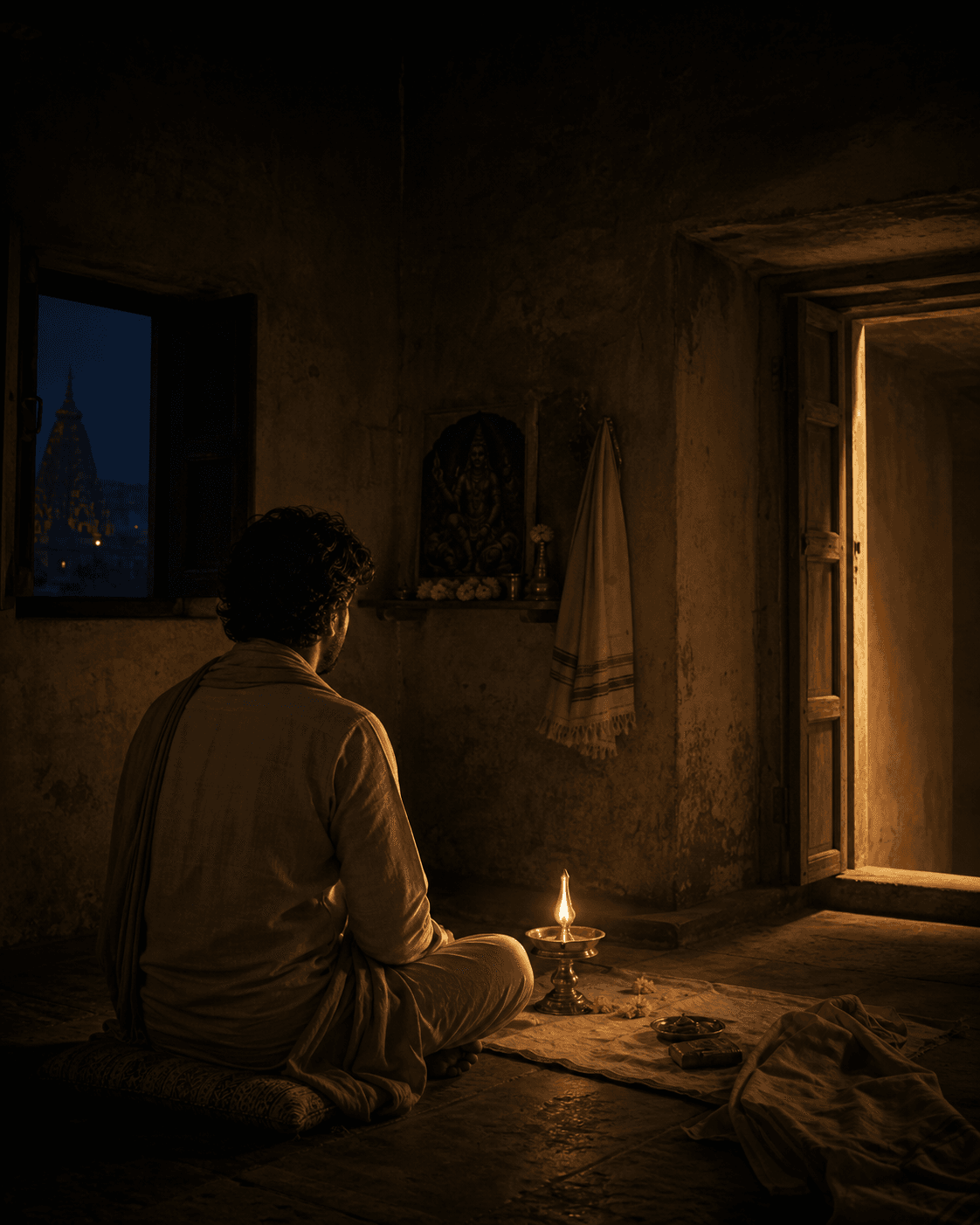
This booklet is part of The Inward Fire Series. Artworkdirection:dark-golddevotional-literarystyle,restrainedsacred atmosphere, silence, grief, solitude, and the interval between inner cry and outer duty.
Depth without theatrics. Devotion without performance. © Sasidhar Valluru. All rights reserved. AUTHOR’S NOTE This booklet comes after the eleventh booklet,When Happiness Refuses to Stay. That booklet asked why happiness cannot become the final anchor. Happiness comes. Happiness goes. So does sadness. Both are real. Both are powerful. Both can teach. But neither can hold the whole weight of life. This booklet begins at a more dangerous place. What happens after happiness has gone, after sadness has burned through the house, after purpose itself has fallen silent, and the person is left asking: what now? This question did not come to me in a lecture hall. It did not come while reading a commentary in comfort. It came inside my own house, beside someone I love, after grief had asked questions for which I had no answer. The person was my wife. I do not write that to expose her. I write it because otherwise the reader may think this is a theory about grief. It is not. It is a reading born from a room where one person was asking how to face tomorrow, and another person was trying not to convert pain into advice.
THE INWARD FIRE SERIES | BOOKLET THIRTEEN5 There is also one practical boundary. This booklet is not medical advice. Grief, depression, OCD, trauma, suicidal thoughts, and severe emotional distress need care, support, therapy, medicine, family, safety, and professional help where needed. Spiritual language should never become an excuse to ignore danger. If the body is bleeding, one does not debate metaphysics before bringing cloth and pressure. The same applies to the mind. But there is also a spiritual fact hidden inside grief. Sometimes the soul cries out. The cry meets silence. The mind keeps asking. Silence does not move. Then the mind exhausts itself. The person gives up inwardly. For a moment, there is peace. Not happiness. Not solution. Not explanation. Peace. This booklet is about that moment. The mistake is that we often file that peace under grief. We think the wound created it. We associate the Presence with the event that broke us open. But grief did not create Bhagavān. Grief did not create the jīva. Grief only cracked the surface noise long enough for the seeker to notice what had always been there. Vijñāna Bhairava Tantra becomes important here. It does not merely give doctrine. It points to entry-points. The gap between breaths. The pause between thoughts. The shock before naming. The stillness between two movements. The wedge between extremes. This booklet asks whether grief also opens such a wedge, and whether sādhana is the art of entering that doorway without waiting for life to break the door open.
6THE INWARD FIRE SERIES | BOOKLET THIRTEEN CONTENTSThe Sacred Interval
Author’s Note5 Opening: Between the Cry and the Chore8 The Project-Engine of Happiness11 Life Purpose and the Six-Year-Old’s Certainty13 When the Fixer Reached the Door He Could Not Open16 Good Deeds Are Not Insurance Policies19 Questions That Met Silence22 The Moment After Giving Up25 Vijñāna Bhairava and the Wedge Between Extremes28 Misfiling the Presence Under Grief31 Obsessive Capture and the Mind Without an Object33 The Medicine Called Boredom36 The Doorway Without the Wound39 The Next Rightful Action42 The Gist44 Epilogue: Before the Next Work Arrives46
THE INWARD FIRE SERIES | BOOKLET THIRTEEN7 OPENING
Between the Cry and the Chore
There is a moment after grief has screamed and before life starts dragging the person back. That is the interval. On one side, the inner world is burning. Questions rise with the force of accusation. Why me? Why him? Why now? What did we do? Why did Bhagavān allow this? Why did all this goodness not protect us? On the other side, the outer world is already tugging. The child has to eat. The body has to bathe. The phone is ringing. Relatives are arriving. Papers have to be signed.Workwilleventuallycall.Tomorrowwillcomewithshameless punctuality. The world does not ask whether the soul is ready before turning the next page. Between these two forces there is a small space. The cry has exhausted itself. The chore has not yet fully taken over. The mind cannot go backward into the old life. It cannot yet move forward into the new one. It stands suspended.
8THE INWARD FIRE SERIES | BOOKLET THIRTEEN Most people call that emptiness. Some call it shock. Some call it numbness. Some call it depression. Some call it boredom later, when the immediate crisis passes and no new project has arrived. But there is another name. The sacred interval. Not all silence is sacred. Some silence is avoidance. Some silence is neglect. Some silence is emotional shutdown. Some silence is cruelty dressed as calmness. Let us not romanticize every frozen face. But there is a silence that comes after the mind has spent itself. The person has asked, accused, bargained, cried, trembled, and fallen inward. No answer comes. No explanation comes. No cosmic customer-care executive opens a ticket. And yet, for a moment, the person is not fighting. That moment matters. Because in that moment, the seeker is closer to truth than in many hours of clever speech.
THE INWARD FIRE SERIES | BOOKLET THIRTEEN9
Chapter 1
The Project-Engine of Happiness
Human beings convert life into projects. A job is a project. Marriage is a project. Children become projects. Education becomes a project. Health becomes a project. Social standing becomes a project. Even spirituality becomes a project if the ego gets hold of it fast enough. Every project has a start, milestones, effort, hope, fear, measurement, and expected yield. If the project succeeds, happiness comes. If it fails, sadness comes. This is not wrong. Happiness is not the enemy. Sadness is not the enemy. A person who pretends not to enjoy joy is usually either lying, frightened, or auditioning for a spirituality poster. If food is good, eat. If a child laughs, smile. If work succeeds, be grateful. If love arrives, receive it. If the train window shows beautiful fields, look. The old seekers did not forbid happiness because happiness is dirty. They warned us because happiness does not stay.
THE INWARD FIRE SERIES | BOOKLET THIRTEEN11 They did not tell us to become stone. They told us not to become kidnapped. That is the key. When happiness comes, enjoy it without making it king. When sadness comes, let it cleanse without making it the owner of the house. When either one becomes too large, step aside. Watch. Breathe. Remember. Offer. Equanimity is not anti-joy. Equanimity is anti-abduction. This is why the Gita’s teaching on action and result is so practical. It is not meant only for monks or battlefield heroes. It is meant for every person whose mind trembles before outcome. Do the work. Offer the work. Receive the result. Learn from the result. But do not hand over the throne of the inner life to the result. That is simple to say. Then grief arrives and tests whether we meant any of it.
12THE INWARD FIRE SERIES | BOOKLET THIRTEEN
Chapter 2
Life Purpose and the Six-Year-Old’s Certainty
People love saying, “This is my life purpose.” Perhaps it is. Perhaps it is only a six-year-old inside us speaking with steel in his voice, declaring that when he grows up he will become a postman, constable, pilot, king, astronaut, or superhero. There is nothing wrong with the six-year-old. Let him speak. Let him dream. Let him point somewhere with full seriousness. Childhood certainty has its own beauty. But adulthood should know the difference between direction and possession. Many life purposes are simply larger projects with better lighting. They give the mind a structure. They give the ego a banner. They make suffering feel organized. They tell us why we are getting up tomorrow. Again, this is not bad.
THE INWARD FIRE SERIES | BOOKLET THIRTEEN13 A person needs direction. A house needs routine. Children need food. Work needs discipline. Society cannot be run by people floating around saying, “I am beyond purpose.” Usually such people are not beyond purpose. They are beyond usefulness. But when life purpose becomes self-ownership, māyā smiles. The person begins to think: this is mine. This is why I exist. This is my mission. This is my identity. This is what makes my pain meaningful. This is what gives me the right to continue. Then life breaks the project. Now what? This is where the childishness of many purpose statements is exposed. Not because purpose itself is false, but because we expected it to carry the whole load of existence. A real inward journey must eventually ask a harsher question. If the project falls apart, do I still know how to be? If the mission changes, do I still know how to stand? If the person for whom I lived is gone, do I still know how to love what remains? If Bhagavān is silent, do I still know how to sit in His presence? That is where this booklet begins.
14THE INWARD FIRE SERIES | BOOKLET THIRTEEN
Chapter 3
When the Fixer Reached the Door He Could Not Open
People had come in throngs. They came because death had entered the house. They came because my son’s body was being taken away. They came because that is what people do when grief becomes public. Some come with love. Some come with helplessness. Some come because community has its own dharma. Some come because they do not know what else to do. My wife was crying. Through her tears, she asked me a question that only grief can ask. “You can fix anything. I have seen you do that. You are saving lives at your firm. You fixed so many people’s lives. You gave career guidance, life guidance, opportunities. You helped people through charities. Why can you not fix this?” There are questions that do not need clever answers. They need truth. My answer was calm, not because I was above grief, but because something else had already answered me with silence. “I do not have the answer to every question. I asked and received silence. Bhagavān is close to you too. You try.” That was the first answer. Then came the second.
16THE INWARD FIRE SERIES | BOOKLET THIRTEEN “Yes, I can do many things. But fixing this would amount to an act for myself. I never asked Bhagavān to give me power to fix myself for my benefit. I always asked Him to be with me and guide me. I am working on His purpose, His power, and His will. I do not own anything. You are asking the wrong person.” That last line is the hinge. You are asking the wrong person. It was not helplessness. It was not evasion. It was not fatalism. It was the boundary between instrument and Source. I can act where action is given. I can serve where service is given. I can guide where guidance is given. I can build where building is given. I can hold where holding is given. But I am not the Source. Whatever power moved through me was never mine. This is the correction that grief sometimes forces upon the so-called capable person. The world may see him as a fixer. Family may see him as a fixer. Teams may see him as a fixer. Even he may have quietly become used to that role. Then comes one door his hands cannot open. That door is terrible. It is also truthful. It says: instrument, know your place. Not as insult. As liberation.
THE INWARD FIRE SERIES | BOOKLET THIRTEEN17
The free reading ends here
10 more chapters to read
One email. The rest opens here, and you'll hear when the next booklet is ready.