The Series / Booklet Five
Booklet Five
The Witnesses Who Remain
Chiranjeevis, Memory, Atonement, Mercy, and the Long Work of Bhagavān
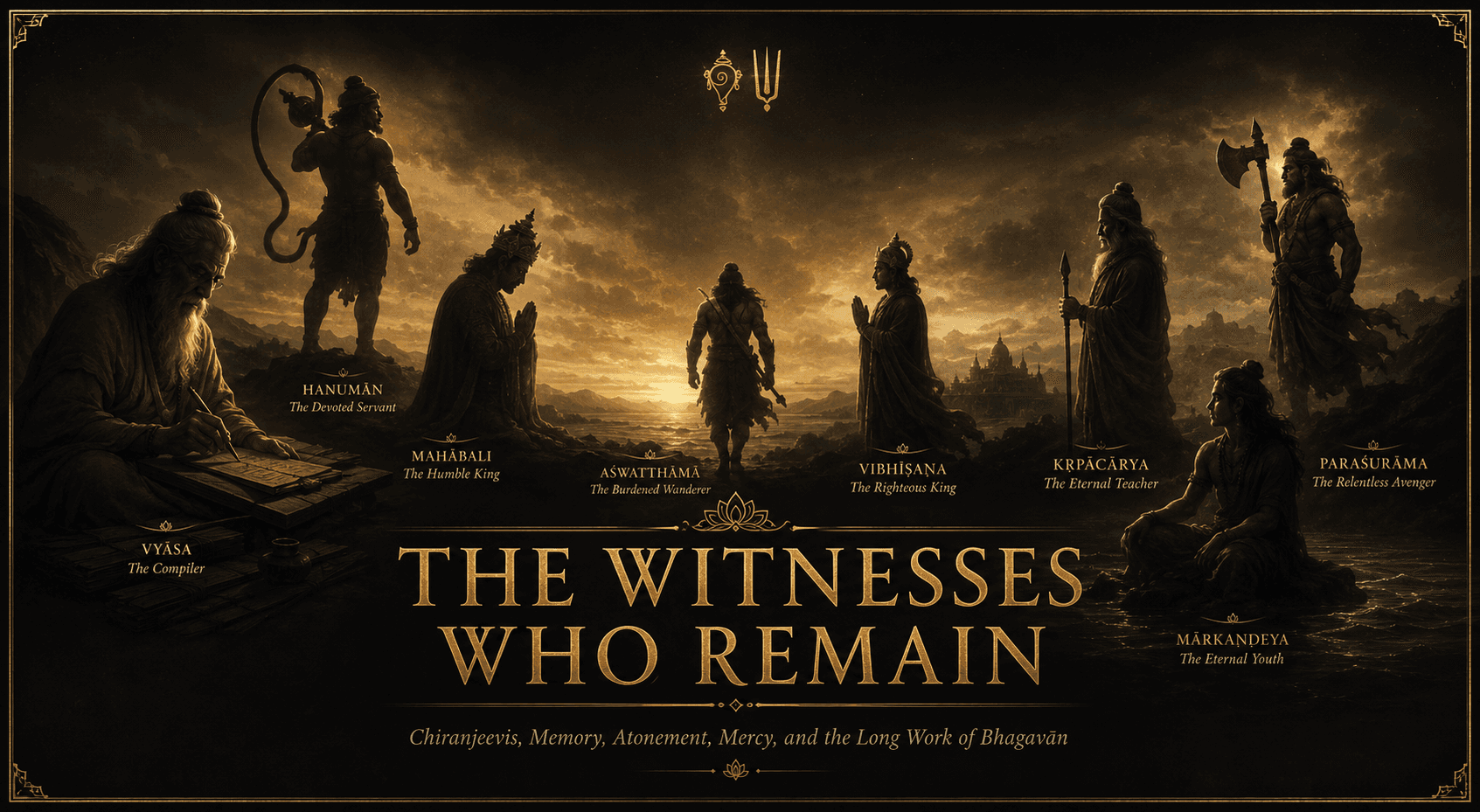
Vyāsa, Hanuman, Mahabali, Aśvatthāma, Vibhīṣaṇa, Kṛpācārya, Paraśurāma, and Mārkaṇḍeya do not sit neatly in one moral box. This booklet asks what truth each one carries, what remains unfinished, and why Bhagavān’s work is long enough to hold consequence, atonement, duty, mercy, and grace together.
Booklet Five
Opens as a book: turn the pages, set the type and paper, and pick up where you stopped.
The Witnesses Who Remain
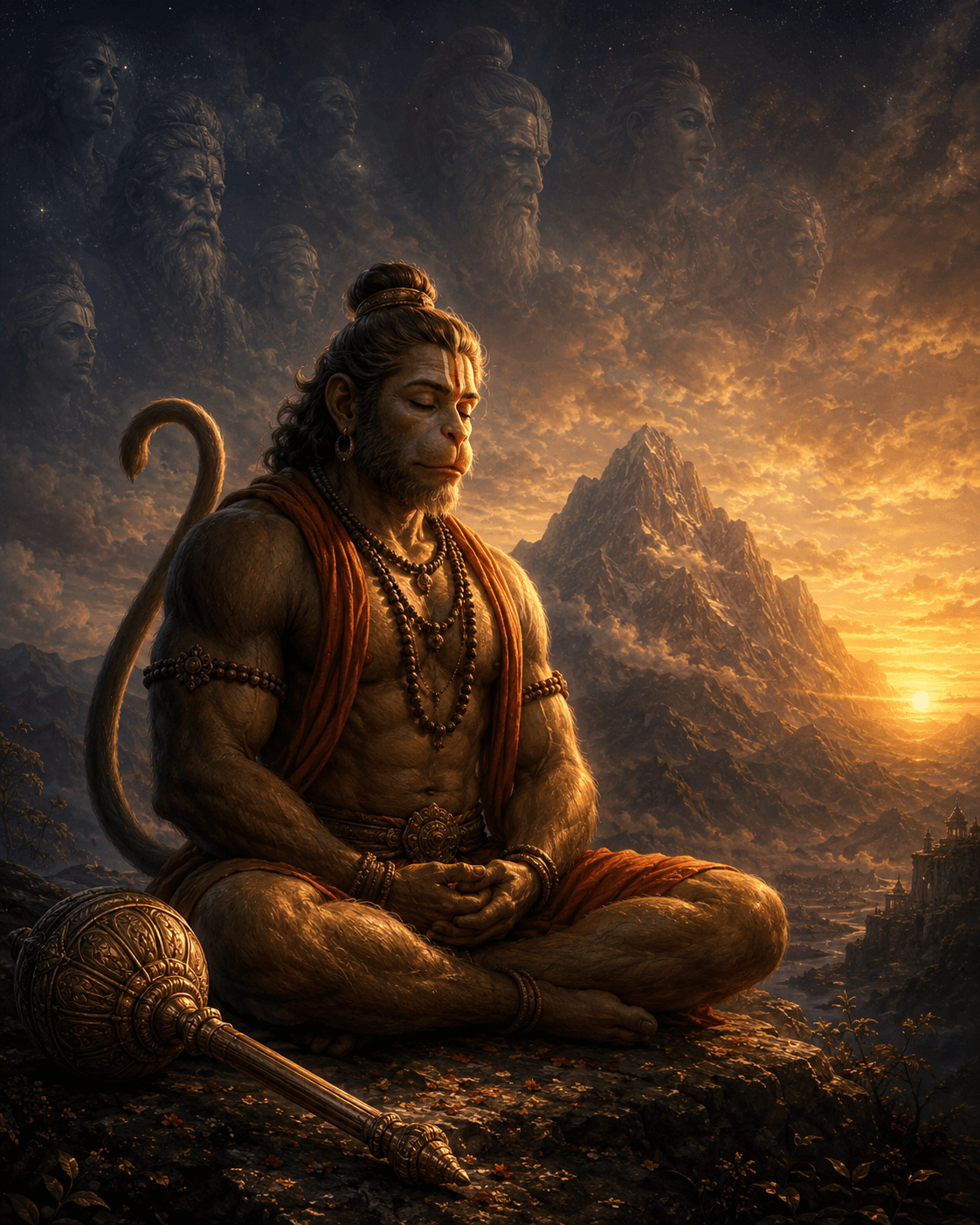
Cover image: AI-generated concept artwork based on the Booklet Five theme - Hanuman in meditation, strength surrendered into stillness, the witness who remains.
Author’s Note
This booklet follows naturally from the fourth. The fourth booklet asked what happens when the seeker stops treating life as an optimization problem. It asked whether responsibility can become ego in work clothes. It asked why even accomplishment does not settle the heart. It asked why surrender is not a service we render to Bhagavān, but medicine for our own restless instrument. This booklet asks the next question. If the body is not final, if accomplishment is not final, if knowledge itself does not guarantee peace, why do certain beings remain? Why Chiranjeevis? As a child, I never fully understood this idea. Immortality sounded strange enough. But why would immortality be given to such different beings? Vyāsa, Hanuman, Vibhīṣaṇa, Bali, Paraśurāma, Kṛpa, Aśvatthāma. In some traditions, Mārkaṇḍeya too stands in that great memory of death being crossed or delayed by grace. The lists vary. That does not disturb me. I am not writing a census report for eternity. I am not here to count heads in Bhu-loka like some cosmic attendance clerk with a clipboard. The point is not merely who remains. The point is why a tradition would preserve the idea that some beings remain. The answer that came to me is simple. They are witnesses. Not decorative immortals. Not fantasy leftovers. Not purāṇic museum pieces. Witnesses. Each one carries a lesson that human beings keep failing to learn. Knowledge is not enough. Strength is not enough. Victory is not enough. Birth is not enough. Royalty is not enough. Tapas is not enough. Loyalty is not enough. Even punishment is not the end if atonement remains possible. This booklet does not claim that all Chiranjeevis are perfect saints. That would be childish. Nor does it claim that adharma becomes acceptable because a being later receives a place in divine memory. That would be worse than childish. That would be dangerous. The point is subtler. Bhagavān is guṇātīta. Nirguna. Beyond the boxes we draw. He is not shallow enough to demand only one visible behavior pattern, one approved devotional posture, one social form of goodness, or even only direct surrender to Him. But that does not make adharma acceptable. In the manifested world, dharma matters. Consequence matters. Atonement matters. Redemption matters. Surrender matters. Duty matters. Mercy matters. The Chiranjeevis remain because the lesson is not finished. Bhagavān’s work is long. Human stupidity is also long. Grace, thankfully, is longer.
Opening: Why Would Anyone Remain?
1. Bhagavān Is Beyond the Boxes We Draw 2. The Chiranjeevi as Witness, Not Ornament 3. Vyāsa: Knowledge Is Not Enough 4. Hanuman: The Body as Temple 5. Mahabali: The Emperor Who Offered His Head 6. Aśvatthāma: Wound, Rage, Atonement, and Future Ṛṣihood 7. Vibhīṣaṇa: Mercy Is Not Weakness 8. Kṛpācārya: Duty Without Glamour 9. Paraśurāma: Power Exhausted into Inquiry 10. Mārkaṇḍeya: The Child Who Crossed Death 11. The Long Work of Bhagavān 12. The Gist
Epilogue: The Fire Returns Inward
Opening
Why Would Anyone Remain?
The idea of Chiranjeevis disturbed me as a child. Not frightened. Disturbed. Why should anyone remain for so long? Why should anyone be allowed to remain? If life has its rhythm, if the body comes and goes, if even great kings and sages must pass, what is this strange exception? And even if such an exception exists, why these people? Vyāsa, I could understand somewhat. Hanuman, of course. Vibhīṣaṇa, perhaps. Bali, yes, with some thought. Paraśurāma and Kṛpa, all right, depending on the doorway through which one enters the story. But Aśvatthāma? The man who tried to destroy the unborn child in the womb? The man whose rage entered one of the darkest moral zones in the Mahabharata? Why should he remain? Why should he be included in any list that also includes Hanuman? This question stayed somewhere in the background for years. It did not sit in front of me every day. It was not some urgent theological puzzle making me miss lunch. But it was there. Then, slowly, the answer changed shape. The immortal part cannot be the body in the simple sense. The ātman is anyway not destroyed. The body is not the final truth. So Chiranjeevitva cannot merely mean a biological system refusing to shut down like a stubborn old generator. The special thing must be different. They remain available to the loka. They remain in relation to this field. They remain as memory. They remain as witness. They remain because the lesson they carry has not exhausted its relevance. That changed the whole question. The question is not: why did they not die? The question is: what truth needed them to remain? Once that question opens, the Chiranjeevis stop looking like a list of mythological anomalies. They become a map of what human beings keep mishandling. Knowledge. Strength. Surrender. Duty. Mercy. Atonement. Humility. Continuity. Refuge. That is the doorway of this booklet.
Chapter 1
Bhagavān Is Beyond the Boxes We Draw
Before speaking of the Chiranjeevis, one confusion must be removed. Bhagavān is guṇātīta. He is not trapped inside sattva, rajas, and tamas. He is not limited by the categories we draw. He is not merely the protector of whatever human beings happen to call respectable. He is not a school principal with a checklist of approved spiritual behavior patterns. He is nirguna. Nirākāra. Nirañjana. Beyond our tidy boxes. The manifested world is not made of one flat moral texture. The lion hunts. The deer grazes. The river flows. Fire burns. Wind moves. Each being moves according to svabhāva, guṇa, karma, and the law of its own field. But this must not be misunderstood. The human being cannot excuse cruelty by pointing to the lion. The seeker cannot excuse darkness by calling it svabhāva. Rage does not become dharma because it began in pain. Loyalty does not become purity because it feels intense. Bhagavān includes all beings. He does not sanctify every action. That distinction is essential. Otherwise, the whole discussion collapses into moral sludge. Some fellow will declare, “This is my nature,” and then proceed to behave like a leaking drain with philosophical vocabulary. No. That is not dharma. That is self-excuse wearing sacred thread. In the manifested field, dharma matters intensely. The body acts. The mind chooses. The tongue speaks. Power moves. Wounds react. Duty calls. Desire pulls. Fear distorts. The guṇas churn. Karma accumulates. So adharma remains adharma. But consequence is not eternal rejection. That is the next correction. If one errs, consequence follows. If one wounds, the wound returns. If one violates dharma, the violation must be borne. But Bhagavān does not say, “You are finished forever.” Hindu thought does not require permanent damnation to take sin seriously. It can hold consequence and redemption together. Atonement is real. Redemption is real. Surrender is real. And full surrender, in its unconditional form, can take the jīva beyond the chakra itself. But even there, one must be precise. Bhagavān does not need surrender like a needy king demanding tribute. He is complete. One who is everything lacks nothing. Surrender is our need. Our medicine. Our freedom. The jīva may surrender directly to Bhagavān. The jīva may surrender to dharma. The jīva may surrender to duty. The jīva may surrender through nāma, through atonement, through mercy, through truth, through service, through self-offering. Bhagavān is not shallow enough to recognize only one route. But every true route must be aligned to dharma. That is the blade. The Chiranjeevis become meaningful only after this is understood. They are not all preserved because they are perfect. They are not all preserved because they directly surrendered in the same form. Some are preserved because of bhakti. Some because of knowledge humbled. Some because of instinctive surrender. Some because of duty without glamour. Some because they carry a terrible warning. Some because their atonement itself must remain visible to time. Bhagavān is beyond our boxes. Dharma is the bridge by which we cross our own disorder.
Chapter 2
The Chiranjeevi as Witness, Not Ornament
A witness is not merely someone who saw something. That is the small meaning. A real witness carries the event without reducing it. A real witness remembers what the rest of us conveniently simplify. A real witness prevents history from becoming propaganda, spirituality from becoming decoration, and morality from becoming children’s cartoon. This is why the Chiranjeevis matter. Each one complicates easy thinking. Vyāsa does not allow us to say knowledge is enough. Hanuman does not allow us to say strength must be restless. Mahabali does not allow us to say asura means evil, or correction means rejection. Aśvatthāma does not allow us to say devotion automatically purifies rage. Vibhīṣaṇa does not allow us to say mercy is weakness. Kṛpācārya does not allow us to say only glamorous dharma matters. Paraśurāma does not allow us to say power can avoid inquiry forever. Mārkaṇḍeya does not allow us to treat death as greater than refuge. These beings do not sit neatly in one moral box. Good man. Bad man. Hero. Villain. Saint. Sinner. Devotee. Warrior. King. Sage. Survivor. Punished one. Blessed one. The tradition does not behave like a school worksheet. Good. Life does not either. The Chiranjeevis stand where the seeker must stop demanding moral cartoons. The point is not that every action is justified because the being is great. That would be lazy and dangerous. The point is also not that one fall erases everything true, powerful, or sacred in a being. That is also lazy. The real question is sharper. What does this being carry? What did he learn? What did he fail to learn? What does his remaining teach us? What must humanity remember through him? That is why this booklet is not a roll call. It is a reading. The Chiranjeevis are not ornaments added to tradition because people liked supernatural stories. They are preserved tensions. Each one holds a truth that refuses to become simple. And the inward journey needs such truths. Because the ego loves simple labels. Once it labels someone as holy, it stops examining. Once it labels someone as fallen, it stops learning. Once it labels someone as strong, it ignores surrender. Once it labels someone as punished, it ignores grace. The Chiranjeevis break that habit. They remain. And because they remain, the question remains. Have we learnt what they carry?
Chapter 3
Vyāsa: Knowledge Is Not Enough
Vyāsa is the first doorway because he disturbs the educated seeker. If ignorance were the only problem, Vyāsa would be finished. He is not merely learned. He is the arranger of knowledge, the organizer of sacred memory, the composer of civilizational consciousness. He stands behind the Mahabharata. He gives us the Gita as received through that vast itihāsa. He shapes lineage. He sees the Kuru story not as distant spectator but as someone whose own presence is woven into it. He is not a man who lacked information. He is not a man who needed one more workshop. He is not a man who needed a better reading list. And yet, after all that, dissatisfaction remains. That is the wound through which Bhagavatam enters. Nārada comes. Not merely as messenger. Not merely as comic troublemaker with a vīṇā and excellent timing. He diagnoses the missing center. The direct glory of Bhagavān has not been sung fully enough. Knowledge has not become complete surrender. The heart has not been given its final refuge. That matters. Because every age produces people who think knowledge will save them. More books. More frameworks. More systems. More commentaries. More comparative religion. More philosophy. More vocabulary. More confidence while speaking about things not yet digested. Knowledge has dignity. Let us not become foolish in the opposite direction. Ignorance is not spirituality. Laziness is not innocence. Antiintellectualism is not bhakti. A dull mind cannot be made holy by refusing to read. But knowledge has a danger. It can become self-owned. The ego can sit inside knowledge like a landlord inside a palace and say, “Look what I possess.” I know the text. I know the doctrine. I know the Sanskrit. I know the darśana. I know the difference between nirguna and saguna. I know the tattvas. I know the maps. And from the back seat, the ego smiles. It has not died. It has upgraded its library. Vyāsa’s dissatisfaction prevents that arrogance. If Vyāsa himself required Nārada’s intervention, who are we to think our little pile of reading has ended the journey? This is why Vyāsa remains. He remains as witness that knowledge, authorship, access, proximity, lineage, and experience are not enough if the heart has not surrendered. He remains to humble the scholar. He remains to console the writer. He remains to warn the leader. He remains to remind the seeker that being close to the book is not the same as being free. In the fourth booklet, I imagined Vyāsa’s disillusionment partly as the wound of responsibility. He had seen too much. He had been too close to the play. Perhaps he expected more from the human leadership left behind after Krishna’s departure. Perhaps he saw the coming Kali Yuga and felt the ache of discontinuity. Leaders ought to breed more leaders. Not walk away. And yet, even that noble sentence must be surrendered. That is Vyāsa’s fierce teaching. Responsibility must not become ownership. Knowledge must not become pride. Civilizational labor must not become self-claim. The book must be offered back to Bhagavān. That is why the answer to Vyāsa’s dissatisfaction is not more information. It is Bhagavatam. It is singing. It is remembrance. It is love. It is surrender. Knowledge can organize the world. Only surrender can settle the heart.
The free reading ends here
9 more chapters to read
One email. The rest opens here, and you'll hear when the next booklet is ready.