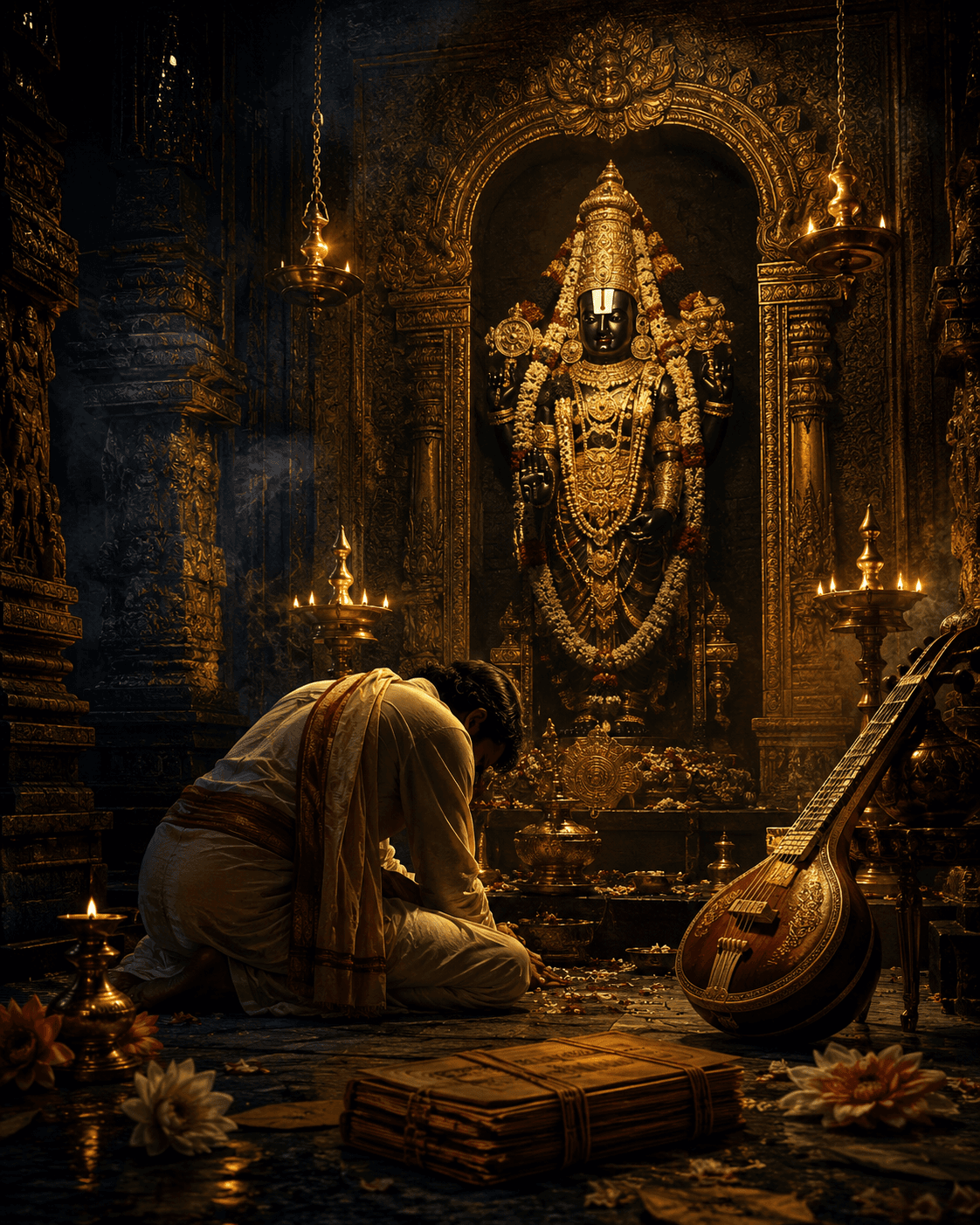

The Series / Booklet One
Booklet One
When the Gods Fall Silent
Dharma, Māyā, and the Inward Journey
A reading through the Gita, Tripura Rahasya, Vijñāna Bhairava Tantra, and Bhagavatam.
The series begins with the core problem: the false center called “I.” This booklet asks how the seeker stands when dharma becomes costly, when knowledge is humbled, when power is tested, and when even familiar gods seem silent. It brings together the Gita, Tripura Rahasya, Vijñāna Bhairava Tantra, and Bhagavatam as a practical inward map rather than a vocabulary collection.

Booklet One
Opens as a book: turn the pages, set the type and paper, and pick up where you stopped.
When the Gods Fall Silent
A reading through the Gita, Tripura Rahasya, Vijñāna Bhairava Tantra, and Bhagavatam
Sasidhar Valluru
Cover photograph: Varanasi ghats, author collection.
Author’s Note
This booklet is the first in The Inward Fire Series. The series is not meant to exhaust Sanātana Dharma. It is meant to stop the seeker from drowning in vocabulary. Each booklet takes one living doorway and asks how it can turn the seeker inward. This first doorway is dharma under pressure: what remains when knowledge is humbled, when māyā is named, when power is tested, and when even the familiar gods seem silent? The next doorway will be nāda: the formless One as sound, Om, Nataraja, poetry, music, dance, and art as worship. A later doorway will return to language, poetry and the mother tongue as a spiritual instrument. But first, we need the map and the furnace.
Opening: Why These Four First
1. The Core Problem: The False Center Called “I” 2. The Gita: The Yogas as Toolkits for Re-alignment 3. Rāma and Jābāli: Dharma Is Not a Fashion Poll 4. Tripura Rahasya: The Journey from Collapse to Consciousness 5. Nirguna, Saguna, Śakti, and the Guṇas 6. Samvartaka: The Man with Nothing to Lose Except Māyā 7. Vijñāna Bhairava Tantra: From Doctrine to Direct Entry 8. Bhagavatam: The Heart Must Be Anchored 9. Brahmajñānis Are Not Moral Cartoons 10. Education, Power, and Jīvodhāraṇa 11. The Harishchandra Test: When Even Gods Are Silent 12. The Four Texts as One Map 13. Māyā Dissolution and the Inward Journey 14. Why Bhagavatam Matters So Much in This Map 15. The Gist
Epilogue: The Next Door Is Sound
Opening
Why These Four First
This is not an attempt to summarize Hinduism. That would be foolish. Too many texts, too many darśanas, too many metaphors, too many sectarian doors, too many beautiful traps. A seeker can get lost in all of it. One person says Advaita. Another says Bhakti. Another says Tantra. Another says Vedanta. Another says Śaiva. Another says Śākta. Another says Vaiṣṇava. Another says Yoga. Another says surrender. Another says inquiry. Another says breath. Another says nāma. Another says nothing matters except grace. All of them may be pointing somewhere meaningful. But for a serious seeker, there is a practical problem: where does one stand? What is the central movement? What is the inward journey actually trying to do? For me, these four texts create a powerful first map. The Bhagavad Gita gives the toolkits of yoga. Tripura Rahasya gives the recognition of Consciousness. Vijñāna Bhairava Tantra gives direct entry-points into that Consciousness. Bhagavatam gives the heart its anchor in bhakti and surrender.
These four are enough to begin.
Not enough to exhaust the tradition. Enough to stop floating. Enough to stop collecting vocabulary. Enough to ask the real question: what is the false separation, and how does it dissolve? But now the map needs its battlefield. Because a clean inward journey is one thing. Dharma under pressure is another. A seeker can speak of Consciousness, surrender, yoga, and māyā while life is still polite. The real test begins when dharma becomes costly, when gods appear silent, when power becomes seductive, when knowledge becomes dangerous, when even the so-called divine field is not free from guṇa-play, envy, pride, grief, and fall. So this booklet has two movements. First, the map. Second, the test of the map. The first movement asks: how does the seeker turn inward? The second movement asks: can the seeker stand when the inward journey is tested by dharma, māyā, power, guṇas, silence, and loss?
Chapter 1
The Core Problem: The False Center Called “I”
The human problem is not merely ignorance in the academic sense. It is not that we lack information. It is not that we have not read enough books. It is not even that we have not performed enough rituals.
The central problem is misidentification.
We mistake ourselves for the body, mind, memory, role, wound, success, failure, relationship, caste, profession, trauma, pride, and fear. We build a center called “I.” Then we defend it, decorate it, and suffer because of it. The world becomes threatening because this “I” feels small. The mind becomes noisy because this “I” wants control. Action becomes bondage because this “I” wants ownership. Knowledge becomes pride because this “I” wants superiority. Even spirituality becomes another costume because this “I” wants to be special. So the inward journey is not about acquiring a new ornament. It is about correcting the false center. That correction can happen through action, devotion, knowledge, meditation, surrender, direct awareness, or grace. That is where the Gita comes first.
Chapter 2
The Gita: The Yogas as Toolkits for Re-alignment
The Bhagavad Gita is not merely a battlefield sermon. It is a complete psychology of spiritual re-alignment. Arjuna is not sitting in a cave. He is not calmly asking metaphysical questions after dinner. He is shattered in the middle of duty. His body trembles, his bow slips, his mind collapses, and his moral framework is overloaded. That is where Krishna teaches yoga. This matters because the Gita does not begin with escape from life. It begins with life becoming impossible to carry through ego alone. Yoga, in the Gita, is not just posture, meditation, or philosophy. Yoga is the disciplined re-alignment of the human being with Bhagavan, with Dharma, with Truth. It is both path and condition. It is the method by which the scattered person becomes integrated, and it is also the state in which that integration becomes steady. So when we speak of yogas, we should not think of them as competing religions. They are toolkits. Each one takes one part of the human being and reorients it toward the Divine.
| Yoga / Marga | What it re-aligns |
|---|---|
| Karma Yoga | Action is offered; duty is performed without egoic ownership of results. |
| Jñāna Yoga | Understanding is purified; the seeker discriminates between the Self and the non-Self. |
| Bhakti Yoga | The heart is anchored in love, remembrance, worship, and dependence on Bhagavan. |
| Dhyāna Yoga | Attention is disciplined; the restless mind is brought into stillness. |
| Abhyāsa Yoga | Repeated effort is sanctified; the mind is brought back again and again. |
| Vairāgya | False dependence is weakened; craving and possessiveness lose authority. |
| Sannyāsa | Egoic doership is renounced; not merely external retirement, but inner dropping of “I am the actor.” |
| Tyāga / Nyāsa | Ownership of action and fruit is surrendered; the burden is placed at Bhagavan’s feet. |
| Śaraṇāgati / Prapatti | The whole being takes refuge; “I am Yours” becomes the deepest truth of the seeker. |
This is not necessarily one official nine-item list in the Gita. That is not the point. The point is more practical. The Gita gives multiple yogic ways to turn the seeker inward and upward. It does not allow any part of the human being to remain unconverted. Your action must be offered. Your thought must be clarified. Your heart must be softened. Your attention must be steadied. Your ego must be surrendered. Your burden must be placed where it belongs. In simple terms, we are not going somewhere else to find Him. We are removing what makes us feel separate from Him. This must be said carefully. In an Advaitic language, one may say: we are already That. In a bhakti language, one may say: we were never apart from Him; we only mistook ourselves to be independent, separate, and self-owned. Both formulations are useful. The Gita is large enough to hold both. It gives the seeker a practical discipline before the seeker gets intoxicated by metaphysical declarations. That is its genius.
Chapter 3
Rāma and Jābāli: Dharma Is Not a Fashion Poll
The Gita gives the map of disciplined action. Rāma gives us the test of disciplined action. Rāma is not merely a prince wronged by palace politics. He is dharma under exile. He is dharma after loss. He is dharma when the clever argument is available. Jābāli enters the forest with a practical argument. Return. Rule. Do not ruin the kingdom over a dead father’s promise. Do not cling to invisible worlds and ritual obligations. The living need you. The throne needs you. The people need you. Why hold on to a vow when the situation itself has changed? This is not a childish argument. It is sharp. It is worldly. It is persuasive. Many modern minds would applaud it immediately. Rāma’s answer cuts deeper. He does not say: I care whether others believe as I believe. He does not say: my dharma depends on public agreement. He does not say: truth is valid only when society claps for it. The point is harsher. Today’s believers may become tomorrow’s atheists. Today’s atheists may become tomorrow’s believers. Opinion will turn. Fashion will turn. Intellectual climates will turn. But dharma cannot be reduced to the weather of public conviction. Rāma stands because the vow stands. That is why his rebuke to Jābāli matters. In that moment, Rāma is not anti-reason. He is anti-cleverness when cleverness tries to unseat dharma. He is saying: if a minister makes moral convenience sound like wisdom, the king’s house is already in danger. This strengthens the Gita section. Karma Yoga is not merely doing work without attachment. It is doing dharma even when clever people give you excellent reasons to abandon it.
Dharma is not a fashion poll.
It is not built by counting believers and atheists. It is not saved by argument alone. It is protected by the one who stands when the easier road has language, logic, and applause.
The free reading ends here
12 more chapters to read
One email. The rest opens here, and you'll hear when the next booklet is ready.