The Series / Booklet Twenty
Booklet Twenty
When the Maker Hides in the Made
Memory, Body, Māyā, Forgetting, and the Grace Placed Before Birth.
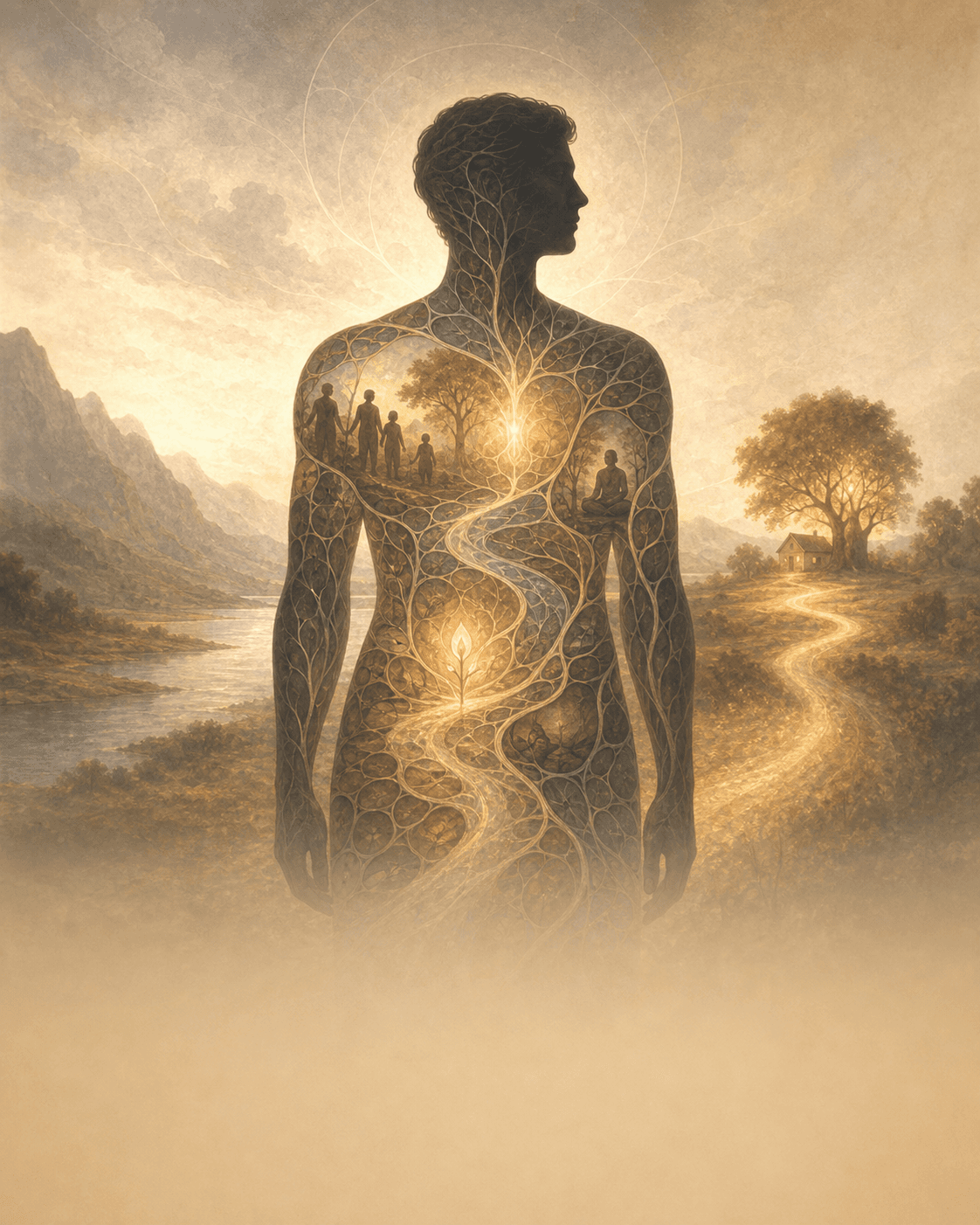
This booklet asks why the jīva does not carry the full working memory of previous lives. One life already holds enough navarasas, enough attachment, enough grief, enough wonder, and enough unfinished emotion. Through a contemplative reading of biology, memory, eggs, sperm, manas, Śakti, Ardhanārīśvara, and the homeward instinct of life, the booklet suggests that Bhagavān does not burden the soul with unnecessary emotional debris. What remains is the deepest relational memory: we are His, He is ours, Mata is near, and homecoming is always allowed.
Booklet Twenty
Opens as a book: turn the pages, set the type and paper, and pick up where you stopped.
When the Maker Hides in the Made
Memory, Body, Māyā, Forgetting, and the Grace Placed Before Birth
MOVEMENT SEVEN · THE LONG WORK AT HUMAN SCALE Sasidhar Valluru THE INWARD FIRE SERIES
WHEN THE MAKER HIDES IN THE MADEMemory, Body, Māyā, Forgetting, and the Grace Placed Before BirthSasidhar Valluru BOOKLET TWENTYMovement SevenThe Long Work at Human ScaleWritten by Sasidhar Valluru The Inward Fire Series First edition
This work is presented as a contemplative literary booklet.
Author's Note
This booklet belongs to Movement Seven of The Inward Fire Series: The Long Work at Human Scale. The nineteenth booklet asked what happens when empathy reaches the gate and cannot enter another person's karmic chamber. This twentieth booklet asks a different question. Was preparation happening before the seeker knew he was being prepared? This question did not come to me as a neat spiritual doctrine. It came through childhood curiosity, school libraries, biology, memory, grief, driving home without thinking, watching animals return at sunset, and wondering why the body preserves some things while letting others change. I am not writing this as a scientist. I am not writing this as a Vedic scholar. I am not claiming that biology proves Bhagavān like a courtroom exhibit. Science must remain science. Where science speaks, it must be treated honestly. Where I draw a spiritual inference, I will call it my contemplation. But I also refuse to pretend that wonder must be banned from knowledge. When I look at how life is made, preserved, edited, replaced, forgotten, and returned, I cannot avoid the feeling that the Maker is hiding inside the made. Science may describe the mechanism. Wonder asks why the mechanism moves the heart. This booklet is about body, memory, māyā, forgetting, mother-line, father-line, the grace of not carrying everything, and the one homeward memory Bhagavān did not erase. Forgetting is not always loss. Sometimes forgetting is mercy.
Opening: The Question That Began in a Library7
1. The Body Does Not Preserve Everything10 2. Capex, Opex, and the Strange Wisdom of Turnover12 3. Memory Before Memory15 4. Why Not Remember Previous Lives?17 5. The Grace of Forgetting19 6. The Egg Before the Mother's Story21 7. The Father-Line and the Moving Spark23 8. The Past in the Mother, the Future in the Daughter25 9. Continuity, Śakti, and Ardhanārīśvara26 10. When the Processes Break28 11. Silence Beneath the System30 12. The Tunnel and the Threshold32 13. The Way Home34 14. What Else Do We Do?37 15. The Gist38
Epilogue: The One Memory Not Erased39 OPENING
The Question That Began in a Library
I did not begin with philosophy. I began with curiosity. In school, I liked looking things up. Sometimes in textbooks. Sometimes in whatever library material was available. Sometimes from the kind of wandering reading that has no exam attached to it and is therefore more dangerous. Biology fascinated me because it did not behave like dead information. It was too intimate. Blood, cells, memory, tissue, eyes, brain, birth, reproduction - these were not distant subjects. They were the machinery through which I was sitting there asking the question. I remember the feeling more than the exact shelf. That is how childhood curiosity works. A line catches somewhere. A fact disturbs you. You do not yet know what to do with it, so you carry it quietly. Later, when life becomes heavier, the old fact returns with a different face. At that age I was not trying to prove Bhagavān. I was not trying to build a system. I was just looking at the body and wondering why it was so selective. Why does one part renew quickly while another seems guarded for decades? Why does memory sit in one kind of continuity while the cells around it may be changing? Why does nature keep some doors open and lock others? At some point, the idea of cell replacement entered my mind. Some cells are replaced quickly. Some slowly. Some structures last far longer than one would casually imagine. Red blood cells circulate for a limited time. Skin renews. Taste changes. Some neurons and lens cells may remain for life. Memory is not one simple box. The body is not one simple machine. Later, I came across more refined discussions: carbon dating of human tissues, slow renewal in some cardiac cells, long-lived neurons, the special status of the eye lens, debates around adult neurogenesis, the hippocampus and memory, the way stress and environment influence the mind-body field. I am deliberately keeping this broad because the science should not be abused for poetry. Details vary by tissue and research continues. But the wonder that first struck me remains intact. I did not have the language then to connect all this to māyā. I was simply disturbed by the intelligence of it. Why does nature replace some things and protect others? Why is the body not entirely disposable? Why is it not entirely fixed? Why does one part churn like operating expense while another part is held like capital investment? Later, as an adult, the old curiosity returned with heavier questions. If we are reborn, why do we not remember previous lives clearly? Why do we not wake up carrying the faces, addresses, quarrels, debts, relatives, heartbreaks, triumphs, and humiliations of another birth? And then a different answer began to appear. Maybe not remembering is not a defect. Maybe it is grace. One life already gives us enough to carry. Why would grace burden us with yesterday's worlds?
Chapter 1
The Body Does Not Preserve Everything
The body is not sentimental. It does not preserve everything just because it once belonged to us. Skin cells go. Blood cells go. Taste buds renew. Hair falls. Nails are cut. Wounds scar. Muscle grows, weakens, remembers, forgets, adapts. The body keeps changing the house while we keep saying, I. This is already strange. The person says, my body, as if the body were one object. But the body is a river pretending to be a statue. Parts are constantly moving, dying, replacing, repairing, signaling, and surrendering their form. Even the microbial world inside and around us complicates the idea of a clean, sealed self. We live with bacteria, viruses, fungi, parasites, immune responses, hormones, electrical signals, chemical messengers, hunger, fatigue, smell, memory, fear, and desire. The body is not a simple private possession. The modern mind likes to say my body, my brain, my memory, my choice. But even that ownership is provisional. Much of what we call choice arrives after chemistry, habit, fatigue, fear, food, sleep, upbringing, genetics, culture, and circumstance have already entered the room. This does not destroy responsibility. It humbles it. Māyā is not only what we see wrongly outside. It is also the structure through which the seer has been assembled. The body is not a prison alone. It is also the instrument through which the jīva receives a world. And yet continuity remains. I wake up and still say I. I remember enough to function. I know my people. I know my routes. I know my work. I know the taste of some foods and the danger of some situations. I carry habits, reflexes, preferences, wounds, skills, and fears that make my life feel continuous even while the body is changing underneath. This is māyā at the human scale. Not fake in the silly sense. Not imaginary in the useless sense. Real enough to live. Changing enough not to be ultimate. The body is a river pretending to be a statue. Māyā is real enough to live, changing enough not to be ultimate.
Chapter 2
Capex, Opex, and the Strange Wisdom of Turnover
The business mind in me cannot avoid the metaphor. In business, if everything is treated as expense, nothing durable is built. If everything is treated as capital, the system becomes frozen, heavy, and foolish. Wisdom lies in knowing what must be spent and what must be preserved. Some parts of embodied life behave like operating expense. They are spent, renewed, cycled, replaced, consumed, replenished. They keep the daily system running. Some parts behave more like capital. They are protected, preserved, invested in, built early, and expected to serve continuity across the life of the organism. I know the metaphor has limits. Biology is not a corporate budget. But metaphors become useful when they reveal a pattern without pretending to replace the thing itself. Why does the body protect some structures so carefully? Why are certain capacities not casually replaced every week? Vision, smell, long-term neural architecture, reproductive continuity, deep cognition - each has its own biological complexity, and science continues to refine the details. And why are other things allowed to churn? Taste can change. Skin can renew. Blood can cycle. Mood can shift. Even manas, the restless mental field through which we react, fear, attach, and interpret, can be trained, damaged, healed, and re-patterned. That is where sādhana and psychology begin to speak to each other, if both remain honest. This made me think: perhaps the body itself is teaching discrimination before philosophy arrives. It says, do not cling to every passing layer as Self. Also, do not despise the instrument through which life is given. But the broad wonder remains. Life seems to know what must be changed and what must be guarded. The body does not say every cell is equally sacred in form. It also does not say everything is disposable. It discriminates. It replaces where replacement is useful. It preserves where continuity is necessary. It edits slowly where fast change would destroy identity. That is not a proof of Bhagavān. But it is a doorway into contemplation. Creation spends what can be spent. It guards what must carry continuity. If the made is arranged with such layered discrimination, perhaps the Maker is not as absent as our despair sometimes claims.
Chapter 3
Memory Before Memory
When people speak of memory, they usually mean autobiography. My house. My school. My friend. My insult. My wedding. My child. My grief. My mistake. My victory. But memory is larger than recall. A seed remembers how to become its plant, though it does not sit there narrating childhood. The body remembers how to heal a cut. The immune system remembers danger in its own way. A newborn knows more than it can explain. A species carries tendencies without carrying diary entries. Genes do not carry autobiography in the way a mind carries a story. They do not say, I lived in that village, loved that person, lost that kingdom, hated that enemy. But they carry functional intelligence. Build this. Repair that. Respond here. Pattern this tissue. Sense this. Fear that. Digest this. Grow this way. Make human tissue, not rabbit tissue. Become this organism, not some random assembly of matter. That too is memory, though not the memory we usually crave. This distinction matters. If I say there is no memory because I do not remember a previous-life face, I may be using too narrow a definition. If I say every instinct is proof of a previous personal story, I may be overreaching. The honest middle is more interesting. Life carries memory as function long before the mind claims memory as biography. That is why I do not need to claim that DNA stores my past-life conversations. It is enough to say that creation carries forward an intelligence deeper than my narration. Perhaps the mistake is that we demand the wrong kind of continuity. We want story continuity. Life gives functional continuity. We want old names. Creation gives structure. We want previous addresses. Bhagavān gives the capacity to walk the next road. We ask for old stories. Grace gives the capacity to live the next one.
The free reading ends here
12 more chapters to read
One email. The rest opens here, and you'll hear when the next booklet is ready.