The Series / Booklet Twenty-One (Capstone)
Booklet Twenty-One (Capstone)
When the Child Stopped Asking
The Capstone Return to Prayer, Presence, and the Relationship That Became Self-Evident
This capstone booklet gathers the first great arc of The Inward Fire Series into a lived recognition. It begins with a nine-year-old child sitting alone in locked defense quarters, holding a small Śiva liṅga and asking only for presence. From that childhood surrender, the journey moves through Arjuna, Rāvaṇa, Duryodhana, dharma, māyā, grief, writing as reliving, Vijayawada, Kanakadurga, Kotappa Konda, Nandi, work, boundaries, peace, humility, and the old question of the Nāsadīya Sūktam. This is not a declaration of final realization. It is the recognition that the map has become terrain, the prayer has become relationship, and the child stopped asking because the relationship became self-evident.
Booklet Twenty-One (Capstone)
Opens as a book: turn the pages, set the type and paper, and pick up where you stopped.
When the Child Stopped Asking
Dream, Darśan, Māyā, Surrender, and the Map Returning HomeSasidhar Valluru CAPSTONE BOOKLETCapstoneThe First Great ArcWritten by Sasidhar Valluru The Inward Fire Series First edition
This work is presented as a contemplative literary booklet.
Author's Note
This booklet closes the first great arc of The Inward Fire Series. It does not close worship. It does not close writing. It does not close nāda, stotram, poetry, prayer, or offering. Those may continue. They may even deepen. If Bhagavān wishes, more hymns may come. More Telugu padyams may come. More Sanskritic-Telugu prayers may come. More doors may open in the movement called Nāda as Offering. But this booklet closes something else. It closes the inward map. The first booklet began with a question: what remains when dharma is tested, when māyā is named, when power is humbled, when knowledge is warned, when surrender becomes the last shelter, and when even familiar gods seem silent? At the time, I thought I was writing a map. Now I see that the map was also evolving me. Or perhaps more truthfully, Bhagavān had been walking me through that map long before I knew I was writing it. Childhood, fear, language, dreams, poetry, grief, work, anger, surrender, darśan, silence, business decisions, family duty, death, and the old stories of Arjuna, Rāvaṇa, Duryodhana, Rāma, Harishchandra, Nala, Vyāsa, and Nārada — none of them were separate chambers. They were one long preparation. This booklet is not a declaration of final realization. That would be foolish. Māyā is too subtle, ego is too polished, and Bhagavān’s work is too vast for a small human being to announce completion like a municipal certificate. This is only my lived seeing. A frightened child once held a small Śiva liṅga in the dark and asked only one thing: Be with me. Years later, after the greatest loss of my life, after writing through grief, after seeing Mother not as a Goddess but as Amma, after returning to work without the old bargains, after seeing that peace is not a place, after even suspecting my own realizations, I understood something quietly: I do not need to ask even that now. He is. I am. With each other. That is enough for this capstone. I thought I was writing a map. Now I see that the map was also evolving me.
Opening: The Prayer That Began Everything8
1. The Child in the Dark11 2. The Only Plan14 3. Why Arjuna Stayed in Memory17 4. Why Rāvaṇa and Duryodhana Were Not Cartoons20 5. Writing as Reliving24 6. Vijayawada: When the Dream Became Darśan27 7. The Lion, the Liṅga, Nandi, and the Secure Child30 8. Vairāgya Enters Operations34 9. Peace Stopped Being a Place37 10. What If This Is Temporary?40 11. The Edge of Knowing44 12. The Map Came Home47 13. The Gist50
Epilogue: The Child Stopped Asking52 OPENING
The Prayer That Began Everything
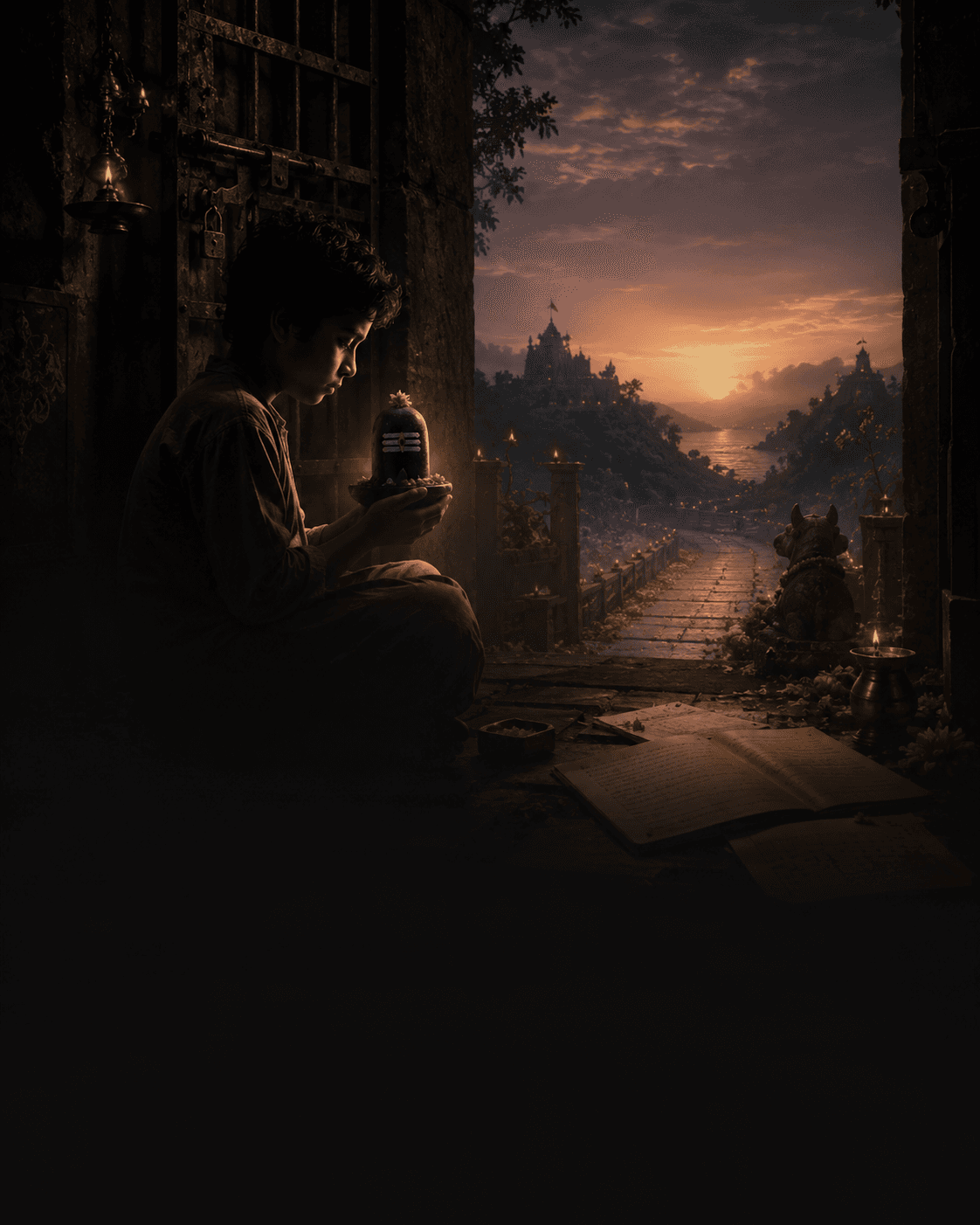
Before scripture, before philosophy, before moksha, before any language of surrender, there was only a frightened child in the dark asking Bhagavān to stay. My first real prayer was not a mantra. I was about nine years old. Balasore, Odisha. My grandfather had died. My parents had gone to Hyderabad. I returned from school and found our large defense quarters locked. A Telugu-speaking neighbour upstairs gave me milk and told me I would stay there until my parents returned. I nodded. Then I asked for the keys. I went home. Bathed. Changed. Did my homework. Ate dinner upstairs. Then I insisted on sleeping alone in my own house. This was not bravery in the clean moral-story sense. It was not some child-hero moment. I was frightened. The house was large. Outside the window there was darkness. No comforting city lights. No crowd. No human reassurance floating in from the street. Just the empty space of a defense colony and a child trying to act bigger than his fear. That first night, I slept in the pūjā area holding a small Śiva liṅga. I did not know proper prayers. I knew a few small couplets. That was all. But even then, something in me felt that this should not matter. My mother had told me Bhagavān is like a father. Parents do not demand formal petitions from a child before sitting beside him. So my prayer was simple. Be with me. That was all. Not give me this. Not remove that. Not make me win. Not make me special. Not protect my future. Not solve my karma. Not grant moksha. Not make sure my funeral rites are performed properly. Not even save me from fear. Just be with me. I did not know then that this was surrender. I did not know that a frightened child, in the dark, with no adult nearby, had chosen the only plan he would ever really have. I did not know that Bhagavān’s work is not only long. It is nonstop. And silent. My first real prayer was not a mantra. It was only this: Be with me.
Chapter 1
The Child in the Dark
Fear did not take the child away from Bhagavān. Fear pushed him into the only refuge that felt absolute. The second night, I carried the small Śiva liṅga into my bedroom. By then another thought had begun to work inside me. If He is everywhere, why should He remain only in the pūjā room? If He is truly Bhagavān, then He is in the bedroom too. He is in the dark too. He is in the corridor too. He is outside the window too. Then another childhood logic arrived. My mother had told me He is Bhūtanātha, Lord of beings. Lord even of bhūtas, pretas, piśāchas, and all the strange beings that children imagine when the lights are gone. So why should I be afraid of them? If they came, I could tell them: we are under the same Lord. I am also His. You are also His. He is with me, around me, inside me. Do not waste my time. Let me sleep. Go play somewhere else. Maybe that is also why Śiva and Kāli entered my childhood so naturally. Not the soft, smiling, family-photo versions of divinity. Śiva with snakes, beings, ash, silence, cremation-ground memory around Him. Kāli in her fierce form, not adjusted into gentle calendar sweetness. To an ordinary child, these were not exactly comforting pictures. But I was not looking for decoration. I was afraid. I was missing my parents. I was in a large house, in the dark, trying to act steady because there was no adult nearby. The mind, or perhaps something deeper than the mind, reached for the only refuge that felt absolute. If He is Father, what do snakes matter? If She is Mother, what does fierceness matter? If the beings around Him are His, then they cannot be outside His household. If Her form is terrible to others, it can still be shelter to the child who knows Her as Amma. That was the strange childhood logic. I did not choose a sanitized God. I clung to the One before whom even fear had to stand down. That thought may sound funny now. But it changed something in me permanently. From then on, I did not know how to ask Bhagavān for things in the usual way. I went to temples. I did pūjā. I folded my hands. I participated in homas and yāgas. I stood like everyone else before the deity. But the inner prayer remained almost the same from that locked house in Balasore. Be with me. Be with me as Krishna was with Arjuna. I will fight my fights. I am not asking You to remove Kurukṣetra. I am asking You to stand in the chariot. Over the years, that prayer took many forms. Sometimes it was Śiva. Sometimes Kāli. Sometimes Durga. Sometimes Lakshmi. Sometimes Krishna. Sometimes just the nameless sense of being held by the One before whom words arrive late. But the relationship stayed parent-child. Not devotee negotiating with cosmic authority. Not scholar discussing metaphysics. Not customer raising service request. Not spiritual aspirant placing career goals before God. Child. Parent. Fear. Presence. That was the grammar. I did not understand then how deep that grammar was. A child asks differently. A child complains differently. A child trusts differently. A child can fall asleep in the lap without asking whether the lap is Advaita, Bhakti, Tantra, Śaiva, Śākta, or Vaiṣṇava. A child simply knows where safety is. That child in the dark did not know scriptures. But he knew where to hold. I did not choose a sanitized God. I clung to the One before whom even fear had to stand down.
Chapter 2
The Only Plan
The child thought he was asking for help. Years later, the adult realized Bhagavān had never been a backup plan. He had been the only plan. Much later, life did what life does. Homes changed. Cities changed. Jobs changed. Countries changed. Teams changed. Roles changed. People came and went. Some stayed. Some mattered. Some hurt. Some helped. Some were helped and still forgot. Some were loved and still wounded. Some stood by. Some stepped away. But when I look back honestly, my personal support system was always small. Almost negligible. This is not a complaint. It is a fact. My wife had a much better support system in many ways. Mine was always thin. Smaller extended family. Childhood experiences that made me retract from seeking empathy. A certain inward habit formed early. When trouble came, I did not instinctively run toward human comfort. I withdrew into that older shell. I spoke to Śiva. I spoke to Mata. I held the inner liṅga. I composed myself. I did what was needed. Then I got back on track. That became my pattern through various trials and tribulations. So when my greatest loss came, even the option of collapse had no practical support structure. I could have broken. I could have melted down. I could have gone into some interior ruin from which people expected me not to return. But even there, I had no backup plan. That sounds harsh. But it is also the truth. Bhagavān was not my backup plan. He was the only plan. I never sought anyone else in that final way. He did not appoint anyone else in that final way. Others may have had roles. Some consoled. Some stood by. Some tried. Some did not understand. Some did not need to. But the inner ground was always Him. That is difficult to describe without sounding either dramatic or sentimental. But I now see it more clearly. He was there. Right through. All along. In childhood fear. In vivid dreams. In language entering as sound. In the books that came. In the stories that stayed. In the weird memory that preserved things. In my instinctive pull toward certain characters. In work. In grief. In silence. In the fact that when I was hit from many directions during my personal tragedy, something still held. Some accused. Some judged. Some attacked. Some took advantage behind my back, thinking perhaps this fellow is not coming back. Some situations began moving in directions that would have hurt further. And then, behind my back, they resolved. By the time I knew, the path had already been cleared. I had been held. Not in the movie-miracle sense. Not with dramatic thunder and celestial announcement. More quietly. More practically. More frighteningly intimately. He was watching my back. This is what surrender gives. Not comfort always. Not public vindication always. Not immediate relief always. Not a polite life. Not guarantee that one’s own people will behave well. Not a clean path. Not even protection from loss. It gives one thing deeper. The one to whom you surrendered does not leave the field. His work is long. His work is silent. His work does not stop because you forgot to recognize it. Once that chord is struck, the music is eternal. Bhagavān was not my backup plan. He was the only plan.
Chapter 3
Why Arjuna Stayed in Memory
A person with ordinary support may admire Arjuna’s skill. A person with weak human support recognizes the real question: who is in the chariot? As I was writing Booklets 19 and 20, Arjuna returned again. Not as a literary device. Not as convenient Mahābhārata reference. Not because I needed a heroic parallel. Something in me finally understood why I always gravitated toward Arjuna. Of course Arjuna is brilliant. Warrior, disciple, friend of Krishna, receiver of the Gita, bearer of Gandiva, the one whom Śiva himself recognizes, the one who enters impossible battles. That is the obvious surface. But that is not why he stayed in me. He stayed because his deepest support was Bhagavān. Again and again, the field around him became impossible. In Pātāla, in Kurukṣetra, before Bhishma, before Jayadratha, before the armies, before his own collapse, before his own questions — Arjuna’s real refuge was not merely his skill. His real refuge was Krishna. Not because Krishna removed every difficulty. He did not. In fact, the presence of Krishna did not make Arjuna’s life easier in the cheap sense. It made his life truer. More demanding. More exposed. More aligned. More impossible to escape. That is why Arjuna matters to me. A person with ordinary support structures may admire Arjuna’s skill. A person with weak human support recognizes something else. When the field breaks, who is with you? Not who claps. Not who advises. Not who posts condolences. Not who says “stay strong.” Not who sends a message and disappears. Who is in the chariot? This is also why Arjuna’s return from silence matters. He collapses. He questions. He cannot carry the moral load. Then Krishna speaks. But the Gita does not manufacture relationship out of nothing. It reveals and clarifies what was already alive between them. Arjuna had already trusted Krishna before Kurukṣetra. The sermon came because the relationship could bear it. That is important. Many people want teaching without relationship. Instruction without surrender. Clarity without exposure. Philosophy without being broken open. They want the Gita as a text, but not Kurukṣetra as condition. Arjuna did not receive a weekend lecture. He received truth in the middle of collapse. That is the kind of figure my memory held. Not the polished hero alone. The devotee who had Bhagavān as the axis when every other axis failed. That is why I remember him. Perhaps my own childhood understood before my adult mind did. The nine-year-old child in the dark had already chosen the Arjuna position. Be with me. I will fight. You stand there. The Gita does not manufacture relationship out of nothing. It reveals what was already alive between Arjuna and Krishna.
The free reading ends here
10 more chapters to read
One email. The rest opens here, and you'll hear when the next booklet is ready.