

The Inward Mirror / Booklet 4
Booklet 4
The Actor Who Forgot He Was Acting
Jīvanmukti, Role, Function, and Action Without a Private Claimant
Janaka still rules, Hanuman still serves, Vyāsa still writes, and the Chirañjīvis still remain within time. This booklet explores jīvanmukti not as withdrawal from function, but as the end of private ownership inside it. The role continues, the body acts, dharma is answered, and work is completed—yet the claimant who says “this is mine” is no longer seated at the center.
Booklet 4
Opens as a book: turn the pages, set the type and paper, and pick up where you stopped.
The Actor Who Forgot He Was Acting
Jīvanmukti, Hanuman, Vyāsa, Śiva Meditating, and the Jīvanmukti, Hanuman, Vyāsa, Śiva Meditating, and the Chiranjeevis Chiranjeevis
Sasidhar Valluru TheValluru.org THE INWARD MIRROR SERIESThe Actor Who Forgot He Was ActingJīvanmukti, Hanuman, Vyāsa, Śiva Meditating, and the ChiranjeevisSasidhar Valluru BOOKLET 4
Author's Note
The Inward Mirror SeriesFirst edition
This work is presented as a contemplative literary booklet. Author’s Note
This booklet interprets the Chiranjeevis as mirrors for function continuing beyond ordinary self-interest. That is a philosophical reading, not a claim that every traditional account explicitly defines them as jīvanmuktas.
The stories remain larger than the use I make of them. Hanuman, Vyāsa, Bali, Kṛpa, Vibhīṣaṇa, Paraśurāma, Aśvatthāma, and Mārkaṇḍeya cannot be flattened into one motivational lesson without committing literary violence.
1. Jīvanmukti Is Not Spiritual Evaporation2. Costume, Role, and the Useful Person3. Janaka’s Court Is the Laboratory4. Hanuman: Service After Knowledge5. Vyāsa Writes After the Map Is Known6. The Chiranjeevis as Preserved Functions7. Prārabdha: The Arrow Already Released8. Function Without the ClaimantThe GistEpilogue
Opening
If realization reveals that the separate claimant was never what it pretended to be, why does the body continue? Why does Hanuman still serve, Vyāsa still write, Janaka still rule, and Śiva still meditate? Should not the enlightened person dissolve into excellent background music?
The confusion comes from assuming that action requires ego. It does not. Ego requires action to advertise itself, but breathing, seeing, deciding, serving, and even fierce work can continue without a private shareholder claiming every movement.
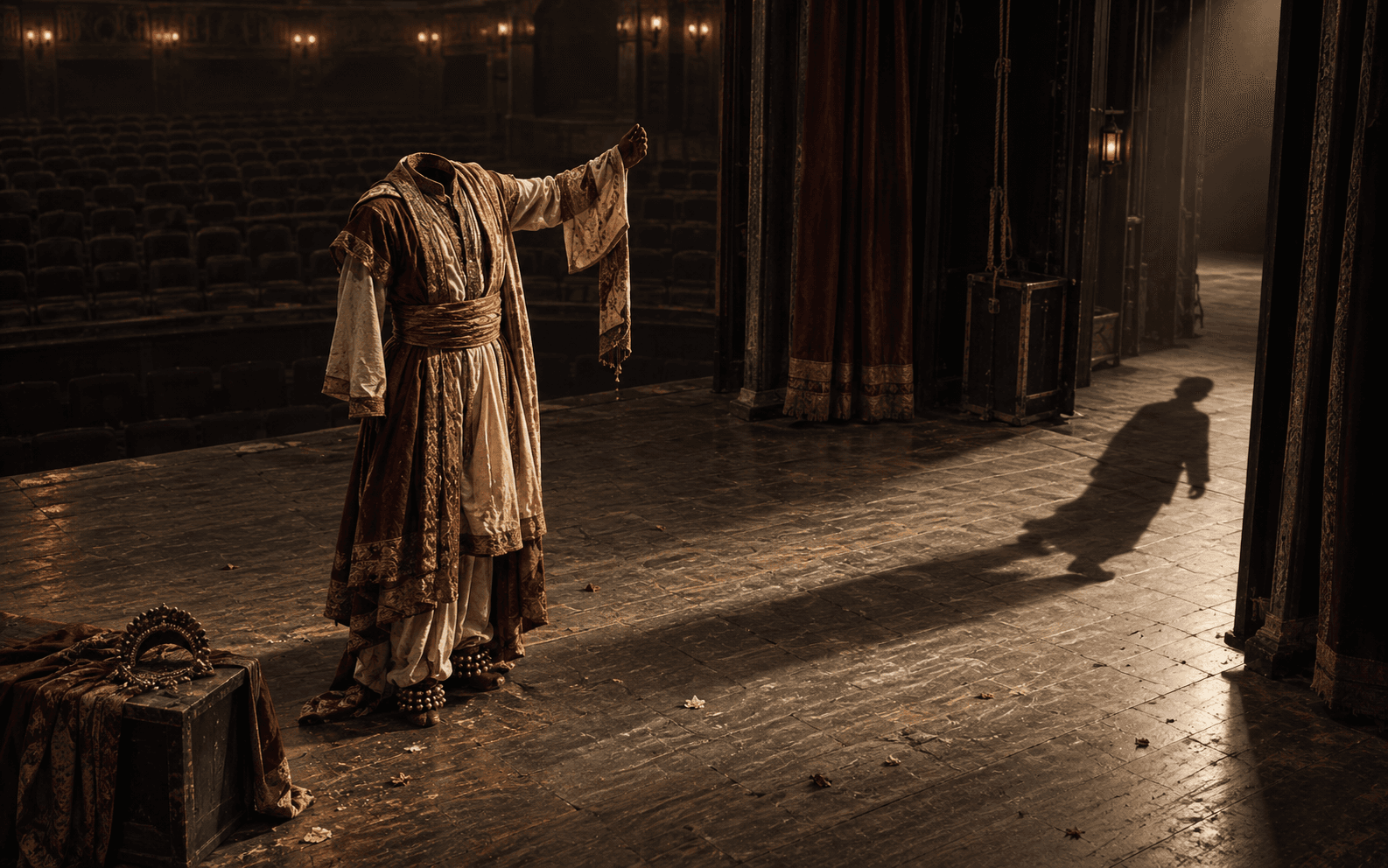
The actor wears the costume. Bondage begins when he forgets the costume is a role and starts taking it home.
Chapter 1
Jīvanmukti Is Not Spiritual Evaporation
Liberation while living does not mean the body becomes decorative vapor. Hunger arrives. Illness can arrive. Old habits may leave grooves. Other people continue being other people in the practical field, which is sometimes the most advanced spiritual test available.
Freedom is not the absence of conditioning in the instrument; it is the end of absolute identification with it. The flute may have scratches. Breath still makes music. Nobody needs to pretend the bamboo has become sky.
Jīvanmukti is therefore not judged by a fantasy of permanent emotional uniformity. The instrument has history, hormones, reflexes, and relationships. What changes is the depth of claim. Anger may arise; it need not recruit an entire identity and a five-year legal case inside the mind. Sensation completes more of its natural arc when ownership stops feeding it.
Chapter 2
Costume, Role, and the Useful Person
A role is not a lie merely because it is not ultimate. Parent, engineer, king, teacher, citizen—each can be inhabited truthfully. The problem is not costume; it is amnesia. When the actor forgets, every criticism of the role becomes a threat to existence.
Recognition permits a more complete performance because less energy is spent defending the performer. Apology becomes possible. Correction becomes cheaper. Success can be used without being worshipped. Failure hurts without becoming metaphysical evidence of worthlessness.
Roles become dangerous when they demand metaphysical obedience. A parent can confuse care with control; a leader can confuse responsibility with indispensability; a teacher can confuse guidance with ownership of students. Remembering the costume does not weaken commitment. It removes the private hunger that bends commitment toward possession.
Chapter 3
Janaka’s Court Is the Laboratory
Janaka is not placed in a cave where consequences are minimal. He governs. That makes him useful. A person can feel spacious during a quiet retreat and rediscover absolute bondage when procurement rejects an invoice.
The court tests recognition through interruption, power, praise, blame, urgency, and competing duties. Janaka’s freedom is not verified by leaving the throne. It is tested by whether the throne enters his identity and begins issuing orders inside the mind.
The court also reveals why realization cannot be merely a private feeling. Decisions affect bodies, livelihoods, and trust. If ‘oneness’ makes a ruler careless about consequence, the insight is incomplete or fraudulent. Practical difference remains the field of dharma. Nonduality is not permission to ignore the person standing before us.
The free reading ends here
5 more chapters to read
One email. The rest opens here, and you'll hear when the next booklet is ready.